ALEXANDER CUBELLIS
Electromagnetism Experiment Design: Identifying the Relationship between Magnetic Strength and the Period of Revolution of a Motor

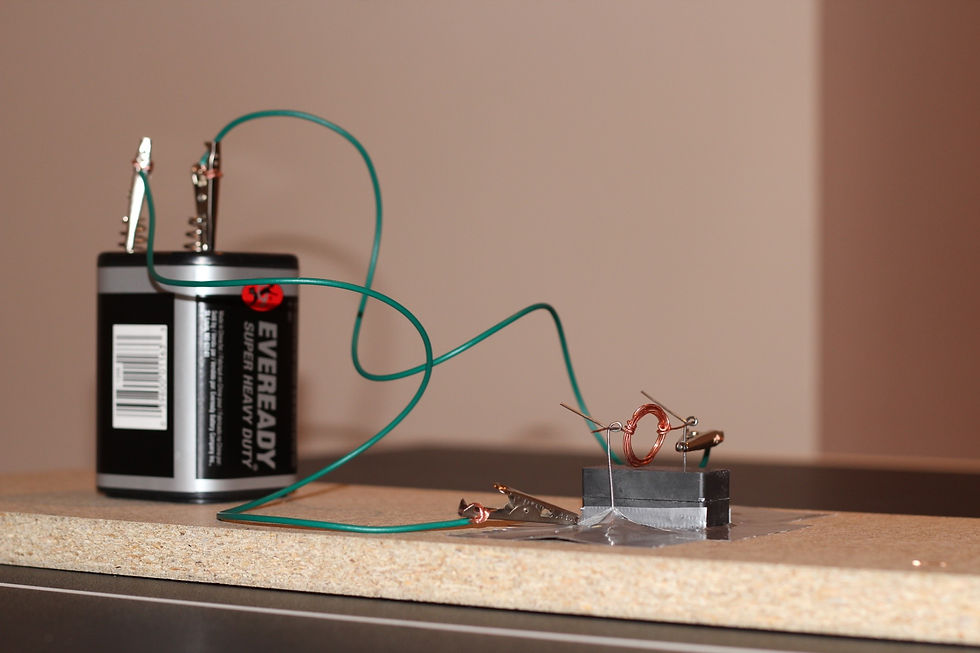
Electric Motor Experiment

In this image it is possible to see the red marking at the bottom of the current loop. In the next image we can see the red marking once again after the current loop has completed a full revolution
Electric Motor Experiment
|
Entry Date |
Time |
Journal Entry |
|
01-13-2012 |
3:30 p.m. |
Goal: Build a simple electric motor that demonstrates the three hand laws while explain the science behind how the motor works.
Materials Needed:
|
|
01-13-2012 |
6:41 p.m. |
Purchased the cell, thin insulated wire, and magnets—have not yet purchased the leads. Going to start building the coiled wire portion |
|
|
7:19 p.m. |
|
|
01-21-2012 |
10:59 p.m. |
Purchased “alligator clamps earlier today and I am about to test them. I want to see if I will be able to conduct a current through the battery to the paper clips, and through the current loop. If the attempt is successful I will video tape it. |
|
01-21-2012 |
11:34 p.m. |
First successful rotations of conductive piece! I will add another magnet to the bottom of the motor and see what the results are. |
|
|
11:35 p.m. |
Qualitative research suggests that the current loop rotation at a much faster rate than before. The current loop was rotating at such a high speed it flew off of the paper clip mount. I will attempt to put some sort of “stopper” (duct tape) to see if this prevents the conductive wire from flying off of the paper clip mount |
|
|
11:40 p.m. |
The friction of the duct tape stopper against the side of the paper clip caused it to melt. See picture. I will try to find something plastic that I can mould around the edge of the conductor to use as an insulator—perhaps this will prevent the melting from occurring.
Observations: I noticed a steely smell emanating from the motor as the conductive wire spins. The paper clips, current loop, and alligator clamps are all warm to the touch. Sparks also appear around the paper clip mount as the current loop rotates |
|
|
11:46 |
I have noticed that after the initial push the current loop travels at a very fast speed and then suddenly it moves only 180 back and forth. Perhaps I need to create some sort of commutator to allow for the current loop to keep rotating in a consistent fashion. |
|
|
11:46 p.m. |
Going to add some additional copper wire to the current loop to see if this helps. Not sure what to expect. |
|
|
12:11 p.m. |
Noticed that putting a separate magnet on the side of the motor caused the current loop to move for a longer period of time, however it was not completing full rotations but rather just moving back and forth |
Purpose/Problem:
As part of a high school design project, I was assigned the task of formulating an experiment that investigated electro-magnetism. Using a reference design experiment on the motor principle I devised an experiment to test the effect of increasing the magnetic field around an alternating current loop. I was also responsible for formulating my own personal hypothesis and testing it to see whether or not my hypothesis was accurate.
Scoping the Problem:
It was required that the experiment be able to be replicated by a grade 11 student and the scientific component of the experiment must be understood based on a grade 11 student’s understanding of electro-magnetism.
Therefore, I created the following list of high level objectives, and constraints to focus how the experiment should be design and what content should be included.
DFX’s:
-
Design for cost, metric: cost ($), cheaper is better
-
Design for transportation, metric: weight (N), lighter is better
-
Design for replication, metric: number of parts, less is better
Constraints:
-
The experiment must not contain any academic content that is more advanced than the syllabus as outlined in textbook Nelson Physics 11
-
If the experimental analysis portion requires the use of software, only the Data Studio Software or Tracker Software could be used
-
The teacher only had licensing rights for Data Studio and Tracker Software. As such, if the experiment required the use of additional software (i.e. for experimental analyses), the student was limited to using the aforementioned software packages. Due to this limitation, the teacher would be unable to view the content of any additional software
The Fractal Stage/Iterative Process:
As part of the assignment, I was required to keep a log (shown below) that summarizes all of the changes and progress that I made in the design process. This log demonstrates iteration and refinement of the experiment. (It is shown at right).
Quantitative Analysis:
Upon completion of the electric motor I was required to test my hypothesis to see if in fact increasing the magnetic field around the current loop (by adding additional magnets) would in fact have an effect on the period of revolution of the loop. To test my hypothesis, I marked a red dot on the loop using a marker and then filmed the motor spinning as electric current ran through the loop. Using Tracker Software, I analyzed the film frame by frame to see how long it took before the current loop completed one full revolution. I discovered that the more magnetic bars were placed under the loop, the faster the motor spun. Therefore, there was a proportionality between the strength of the magnetic field and the period of the revolution of the motor.
The Final Solution:
Therefore, based on the satisfaction of the high level objectives, constraints, and the demonstration that I had in fact developed a testable experiment using quantitative methods, I was able to meet the design principles established in the context of the assignment.